
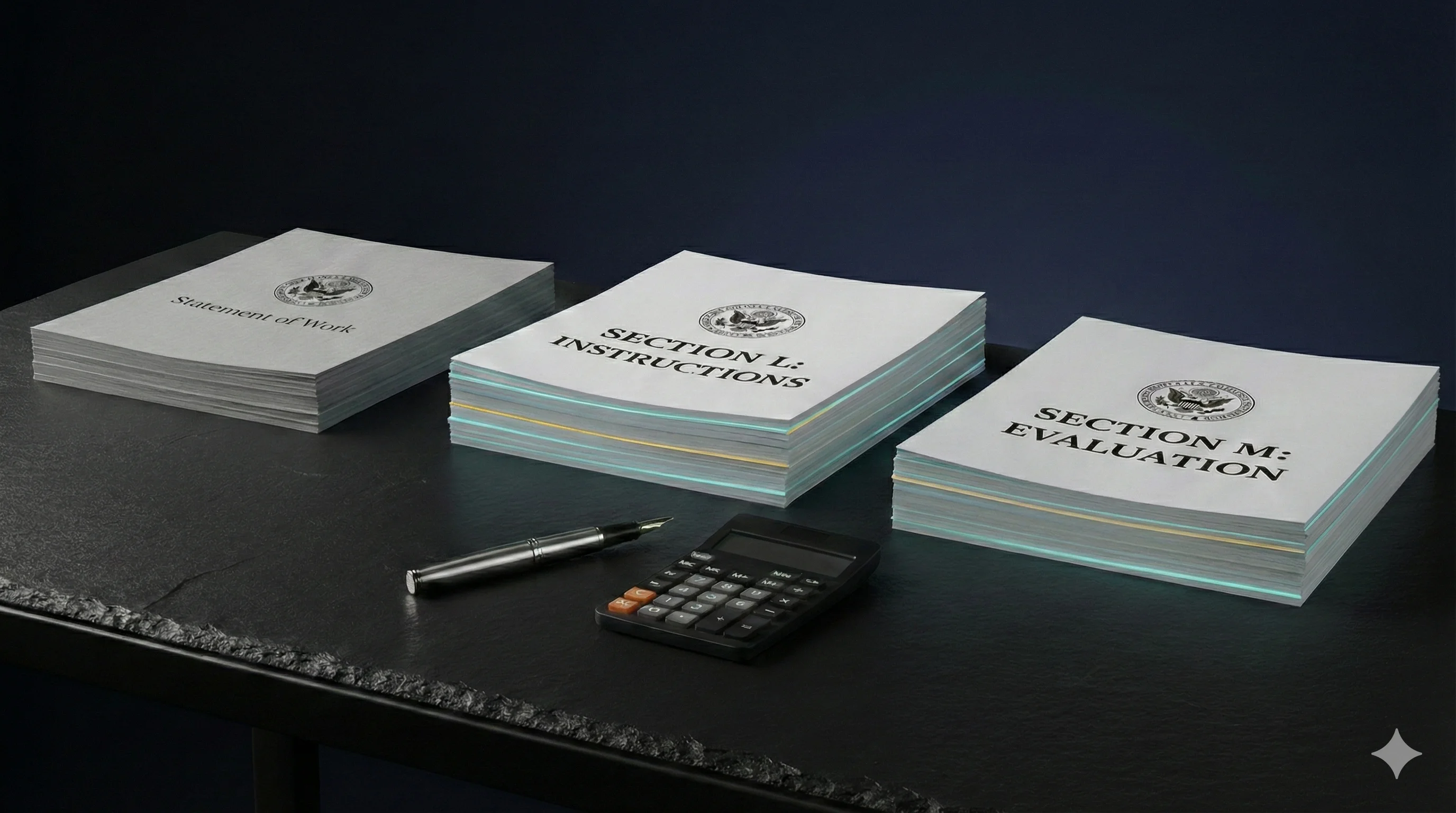
The 15-minute rule: if you cannot finish the same eligibility checklist on every SAM alert before you open Section C, you do not have a triage process. You have hope. Hope is expensive when you are founder-led BD with ten minutes between calls.
This page is the repeatable checklist you run on every alert. For the essay on why Outside-In beats SOW-first (and the five classic disqualifier patterns), read Stop Costly Bid Lotto Tickets: Check Section L & M Gotchas First. Do not try to memorize that essay under deadline pressure. Systematize the sequence below instead.
TL;DR
Run one fixed order every time: set-aside → size/NAICS → FCL/certs → SAM/portals → Section H staffing gates. Log PASS / FAIL / UNKNOWN with a cite. Use AI to draft rows; verify on the PDF and amendments before you care about the SOW.
4:30 PM: what would you do?
A SAM.gov alert hits your inbox. Same hour, a partner forwards a "perfect fit" ZIP. You are one of two BD people at a ~15-person shop. No capture deck. No proposal ops. Ten minutes until your next call.
What do you do first?
Option A: Open the SOW
Skim Section C for keywords. Slack an engineer: "Looks like our stack." Momentum builds before you know if you can submit.
Option B: Run the 15-minute checklist
Work set-aside → size/NAICS → FCL/certs → SAM/portals → Section H staffing in order. Log each gate with a source cite. Stop on the first hard FAIL. Only then decide whether Section C deserves an hour.
Option C: Gut skim and "come back later"
Glance at the synopsis and set-aside line, save the folder, and plan to "do a real eligibility pass tonight." Tonight never happens the same way twice.
The correction: Option B wins. Option A creates emotional investment in a bid you may not be allowed to submit. Option C is how last week's "we already checked" becomes this week's late kill. The artifact is a short pass/fail sheet you can defend in one screen share, not a Pwin workshop.
The 15-minute eligibility checklist
Same sequence on every alert. Do not reorder because the SOW looks exciting. Depth on each gate (why FCL reciprocity fails, how size standards bite) lives in the disqualifiers article. Here you own speed and consistency.
Workflow at a glance
- 1. Set-aside (2 min): total small business, 8(a), WOSB, HUBZone, SDVOSB, unrestricted? Match your status (or JV structure) to the named set-aside.
- 2. Size / NAICS (3 min): confirm the NAICS and size standard; check you are small under that code (or that your teaming structure clears it).
- 3. FCL / certs (4 min): facility clearance level and timing ("at submission" vs post-award); CMMC, ISO, CMMI, or other pass/fail certs named in L/M/H.
- 4. SAM / portals (3 min): active SAM, Reps & Certs, and login access to every named portal or electronic system.
- 5. Section H staffing gates (3 min): key personnel minimums, citizenship, on-site/locality, clearance on named roles, replacement rules you cannot staff.
Log each step as PASS, FAIL, or UNKNOWN with a cite (section, paragraph, or amendment page). UNKNOWN means stop and confirm before any SOW deep-read. FAIL means no-bid (or restructure with a partner who clears the gate) before you burn engineering time.
Re-run the sheet when an amendment drops. Later mods win unless the solicitation says otherwise.
Filled example: pass / fail rows
Fake but realistic rows from a small-business IT services RFP after one focused pass. Your napkin sheet should look like this:
| Checklist step | Requirement | Status | Cite |
|---|---|---|---|
| Set-aside | Total small business set-aside | PASS | SF 1449 block 10 |
| Size / NAICS | NAICS 541512; $34M size standard | PASS | L.3; synopsis |
| FCL / certs | Active Secret FCL at submission | FAIL | L.5.2; Mod 01 p.3 |
| SAM / portals | Active SAM + PIEE proposal portal account | PASS | L.8.1 |
| Section H staffing | Program Manager: U.S. citizen, TS, 10 yrs DoD IT | UNKNOWN | H.12; Attachment 4 |
Decision from this sheet: stop. The FCL FAIL is enough for a documented no-bid (or a partner who holds Secret). Do not spend Friday night on Section C while "UNKNOWN" key-person rows wait for hope.
AI to the rescue: checklist prompt starters
Use a general-purpose model as a fast intern. It drafts candidate rows for your sheet. You still own the PDF.
Prompt 1: ordered gate extract
Prompt 2: pass/fail against my profile
Prompt 3: amendment re-check
Common AI failure modes: inventing size standards, treating "desired" as "required," missing "at time of proposal submission," and skipping portal names buried in L. Fix with forced cites and human PDF verification.
Verification (non-negotiable)
Before you call the checklist done, open the source PDFs (final amendment set) and confirm: every cite, set-aside and NAICS wording, whether "in process" FCL or certs count, portal names and account status, and Section H staffing language as written. AI proposes; you sign off. Re-verify after every amendment.
Why the checklist still breaks under volume
Fifteen minutes works until three alerts land the same afternoon, Mod 02 drops overnight, and you reuse last month's assumptions because "we already know that agency." Consistency under alert volume is an orchestration problem, not a willpower problem.
Unique mechanism
askaGOAT runs the same eligibility sequence across the whole package
Upload the RFP. Get a Hoofnote-style triage that surfaces set-aside, clearance, cert, portal, and staffing gates so you protect BD time before you open the SOW.

Hoofnote: hard gates on one page before you invest a day in Section C.
Triage Your Next RFP FreeNo credit card necessary.
Related reading
Need the why and the five disqualifier patterns in depth? Start with mandatory RFP requirements (Outside-In). When instructions alone are the risk, go deep on Section L.
Do not skip verification because the sheet "looks complete." The expensive misses are almost always one amendment deep.
Frequently asked questions
What is the 15-minute eligibility checklist order?
Run the same sequence on every alert: set-aside → size/NAICS → FCL and corporate certs → SAM and named portals → Section H staffing gates. Log PASS, FAIL, or UNKNOWN with a source cite before you open the SOW.
How is this different from the five disqualifiers article?
The mandatory requirements page teaches Outside-In and the five classic disqualifier patterns. This page owns the repeatable checklist you run on every SAM alert so the method does not live in your head.
What should a filled eligibility sheet look like?
Each row needs checklist step, requirement, PASS/FAIL/UNKNOWN, and a cite. One hard FAIL (for example Secret FCL at submission when you lack it) is enough to stop before Section C.
What must humans still verify?
Open the source solicitation PDFs, including the final amendment set, and confirm every cite, set-aside and NAICS text, clearance/cert timing language, portal names, and Section H staffing rules. AI drafts; you sign off.
Automate the checklist, not the judgment
You can run this 15-minute pass by hand. When alert volume and amendments make consistency break, upload a solicitation to askaGOAT and get hard gates before you invest in the SOW.
Start Your Free TrialNo credit card necessary.